Is a 250W E-Bike Motor Enough for Hills? An Honest Answer for US Riders

If you are shopping for an e-bike in the US, you will run into plenty of models with a 250W motor, often at very tempting prices. And then the obvious question follows: is a 250W e-bike motor enough for hills, or will you be the one doing all the work the moment the road tilts upward?
Here is the honest answer up front. A 250W motor is enough for flat commuting and gentle rolling terrain, especially if you pedal along with it. But for real hills, the kind you find in San Francisco, Seattle, or Pittsburgh, a 250W hub motor will struggle, and on steep grades it will leave most of the climbing to your legs. Whether 250W works for you depends on your hills, your weight, and one detail most buyers miss: whether the motor is in the hub or in the middle of the bike.
What 250W Actually Means on an E-Bike
Watts tell you how much electrical power the motor can draw, but watts alone do not decide climbing ability. The number that matters on a hill is torque, measured in Newton-meters (Nm). Torque is the twisting force that actually pushes you up the slope.
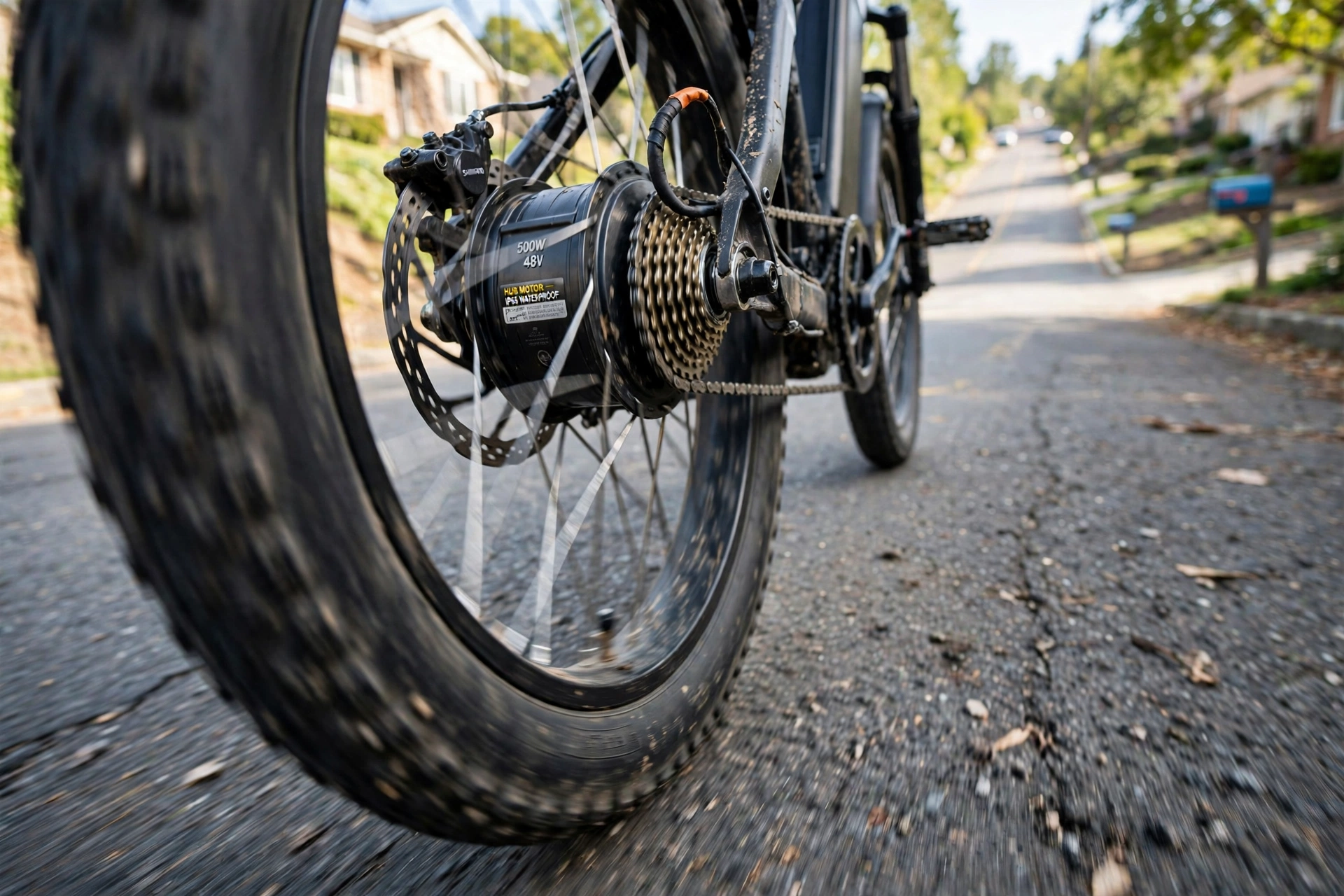
A typical 250W rear hub motor produces around 35 to 45 Nm of torque. That is fine for maintaining speed on flat ground, where the motor mostly fights wind resistance. On a hill, gravity becomes the main opponent, and 40 Nm runs out of authority fast. This is why two motors with the same wattage can climb very differently: a 250W mid-drive motor, which drives through the bike’s gears, can produce 65 to 85 Nm, because the gearing multiplies its force. A 250W mid-drive will often outclimb a 500W hub motor on a steep grade.
So when you see “250W” on a spec sheet, the next question should always be: hub drive or mid-drive? For hill climbing, that distinction matters more than the wattage number.
The Honest Answer, by Riding Scenario

Flat city commuting: yes, 250W is plenty. If your route is mostly level with only short, mild rises, a 250W motor with pedal assist will feel effortless. This is the use case these motors were designed for, and it is why they are so common on affordable commuter and folding e-bikes.
Gentle rolling hills (2 to 5 percent grade): yes, with pedaling. On modest grades, a 250W motor in a medium or high assist level plus steady pedaling will carry an average-weight rider up without drama. You will notice the motor working harder, and your speed will drop, but you will not be grinding.
Steep sustained hills (8 percent grade and up): mostly no. This is where the honest answer turns. On a long 10 percent grade, a 250W hub motor will bog down. Your speed will collapse to 6 or 8 mph even in the highest assist, the motor will run hot and loud, and you will be supplying most of the power with your legs. Short steep pitches are survivable; a mile-long climb is a workout.
Heavier riders, cargo, or kids on board: no. Climbing power has to move total weight. A 200-plus-pound rider, or anyone hauling groceries or a child seat, needs meaningfully more torque than 250W provides. The motor does not know you are heavier; it just runs out of push sooner.
Throttle-only riding on hills: definitely not. A 250W motor can barely move an average rider up a real hill on throttle alone. If you want to climb without pedaling, you need at least 500W, and realistically 750W.
250W vs 350W vs 500W vs 750W: How They Compare on Hills
| Motor power | Typical torque | Hill ability | Typical US price range |
|---|---|---|---|
| 250W hub | 35-45 Nm | Flat and gentle grades only | $600-$1,200 |
| 250W mid-drive | 65-85 Nm | Good on moderate hills (gearing helps) | $1,800-$3,500 |
| 350W hub | 45-55 Nm | Noticeably better; handles rolling terrain | $800-$1,400 |
| 500W hub | 55-70 Nm | Solid all-rounder for most US hills | $1,000-$1,800 |
| 750W hub | 80-100 Nm | Strong climber; US legal maximum | $1,200-$2,500 |
The table makes the key point visible: a 250W mid-drive punches far above its wattage because of gearing, while a 250W hub motor sits at the bottom of the climbing ladder. If your budget only stretches to hub motors, moving from 250W to 500W is the single most effective upgrade for hilly riding.
Why So Many E-Bikes Sold in the US Have 250W Motors
It is not an accident. The 250W limit is the legal standard in the European Union, so a huge share of the world’s e-bike designs are built around it, and many of those designs get sold in the US too. A 250W motor is also smaller, lighter, and cheaper, which is why it dominates folding e-bikes, lightweight commuters, and the sub-$1,000 price bracket.
There is nothing wrong with that, as long as the bike matches the terrain. A 250W folder is a brilliant flat-city machine. The problem only appears when a buyer in a hilly city picks one because the price looked good, then discovers the motor was never meant for their roads.
How to Get the Most Climbing Out of a 250W Motor
If you already own a 250W e-bike, or your budget says 250W is what you are getting, these habits genuinely help on hills.
Pedal hard and use your gears. On a mid-drive, drop to a low gear before the climb starts, not halfway up when you are already struggling. On a hub motor, steady strong pedaling in a moderate assist level beats mashing the throttle, which just overheats the motor.
Carry momentum into the hill. Speed going in is free climbing energy. Where it is safe, build a little pace on the flat run-up instead of starting the climb from a crawl.
Keep your tires properly inflated. Soft tires add rolling resistance, which is a tax you pay on every hill. Check pressure weekly; most e-bike tires want 40 to 65 PSI depending on the tire.
Shed unnecessary weight. A heavy lock, a loaded pannier you do not need that day, and accessories add up. Every 10 pounds matters more on a climb than anywhere else.
Keep the battery healthy. A tired battery cannot deliver full current, and climbing is when the motor asks for the most current. A battery kept between 20 and 80 percent charge and stored indoors will give your motor its best shot on every hill.
When You Should Step Up to 500W or 750W
Be honest about your terrain and your body. If your daily route includes sustained grades over 6 percent, if you weigh over 200 pounds, if you haul cargo or kids, or if you simply want to climb without arriving sweaty, 250W is the wrong tool. A 500W hub motor is the sweet spot for most US riders in hilly areas: meaningfully stronger climbing, still affordable, and widely available.
The 750W motor is the federal ceiling for what counts as an e-bike rather than a motor vehicle in the US, and it is the right pick for the steepest cities, heavy cargo setups, and throttle-heavy riding styles. Just check your state’s class rules, since Class 3 bikes (28 mph pedal assist) face some trail and path restrictions in certain states.
Frequently Asked Questions
Can a 250W e-bike climb steep hills?
Short steep pitches, yes, with strong pedaling. Sustained grades of 8 to 10 percent or more will overwhelm a 250W hub motor; expect very low speeds and heavy leg work. A 250W mid-drive does considerably better thanks to gearing.
Is a 250W e-bike legal in the US?
Yes. Federal rules treat e-bikes with motors up to 750W as bicycles, so 250W is well within the limit. Depending on top assisted speed and whether it has a throttle, a 250W bike falls into Class 1 or Class 2, which are allowed in the most places.
Which climbs better: a 250W hub motor or a 250W mid-drive?
The mid-drive, by a wide margin. Because it drives through the gears, a 250W mid-drive can produce 65 to 85 Nm of torque versus 35 to 45 Nm for a typical 250W hub motor. On hills, gearing beats raw wattage.
Does hill climbing drain the e-bike battery faster?
Yes. Climbing demands sustained high current, which is the fastest way to use up a charge. Expect noticeably less range on hilly routes than on flat ones, and plan charging accordingly.
What wattage is best for a hilly city like San Francisco or Seattle?
For most riders, 500W is the practical minimum for genuinely hilly cities, and 750W is better if you are heavier, carry cargo, or prefer throttle. A 250W hub motor will disappoint on those grades.
Final Thoughts
A 250W e-bike motor is not a bad motor; it is a specific motor for specific terrain. Match it to flat or gently rolling routes and it will serve you quietly and cheaply for years. Point it at real hills and it will tell you the truth every single ride. Buy the motor for the steepest hill on your regular route, not the flattest, and you will never feel underpowered.
Motor power is only one part of a daily ride, so if you are choosing a bike for work, compare the full picture in our guide to the best e-bike for commuting.
Motor power is only part of the picture, so before you decide, see how e-bike classes explained compares pedal-assist and throttle limits for US riders.