
A weak battery is one of the most common reasons a car refuses to start. The good news is that you don’t need a mechanic to check it. Knowing how to test car battery health takes just a few minutes with the right tool. In this guide, you’ll learn simple, reliable methods to check your battery voltage, spot early warning signs, and decide whether it’s time for a replacement. Whether you’re a first-time car owner or someone who likes handling basic maintenance yourself, this article covers everything you need.
Why Testing Your Car Battery Matters
A car battery doesn’t fail overnight. It weakens slowly, and most drivers only notice once the engine won’t crank. Regular testing helps you catch problems early, avoid roadside breakdowns, and save money on emergency towing or last-minute replacements.
Moreover, a healthy battery keeps your alternator, starter motor, and electrical system running smoothly. So, testing it isn’t just about starting your car — it protects the entire electrical setup.
Tools You Need Before You Start
Before diving into the testing process, gather these basic items:
- A digital multimeter
- Safety gloves and eye protection
- A clean cloth
- Baking soda and water (for terminal cleaning, if needed)
A multimeter is the most accurate way to measure your battery’s voltage and overall health. It’s affordable, easy to use, and available at almost any auto parts store.
How to Test a Car Battery With a Multimeter
This is the most accurate and widely recommended method. Follow these steps carefully.
Step 1: Turn Off the Engine and Lights
First, park your car, turn off the engine, and switch off all lights and accessories. Let the battery rest for at least 10 to 15 minutes before testing. This ensures you get a resting voltage reading, not a false one caused by recent engine activity.
Step 2: Set Your Multimeter to DC Voltage
Next, set your multimeter to the DC voltage setting, usually marked as 20V. Connect the red probe to the positive terminal and the black probe to the negative terminal.
Step 3: Read the Voltage
Once connected, check the display. A healthy, fully charged battery should read between 12.4 and 12.7 volts. Anything below 12.2 volts suggests the battery is losing charge, while a reading under 11.9 volts often means it needs replacing soon.
What the Voltage Numbers Actually Mean
- 12.6V or higher – Excellent condition
- 12.4V to 12.5V – Good, slightly discharged
- 12.2V to 12.3V – Weak, needs charging
- Below 12V – Likely dead or failing
Step 4: Perform a Cranking Test
Afterward, have someone start the engine while you watch the multimeter. The voltage may dip briefly but should not fall below 9.6 volts. If it drops lower, the battery may struggle under load, even if the resting voltage looked fine.
How to Test a Car Battery Without a Multimeter
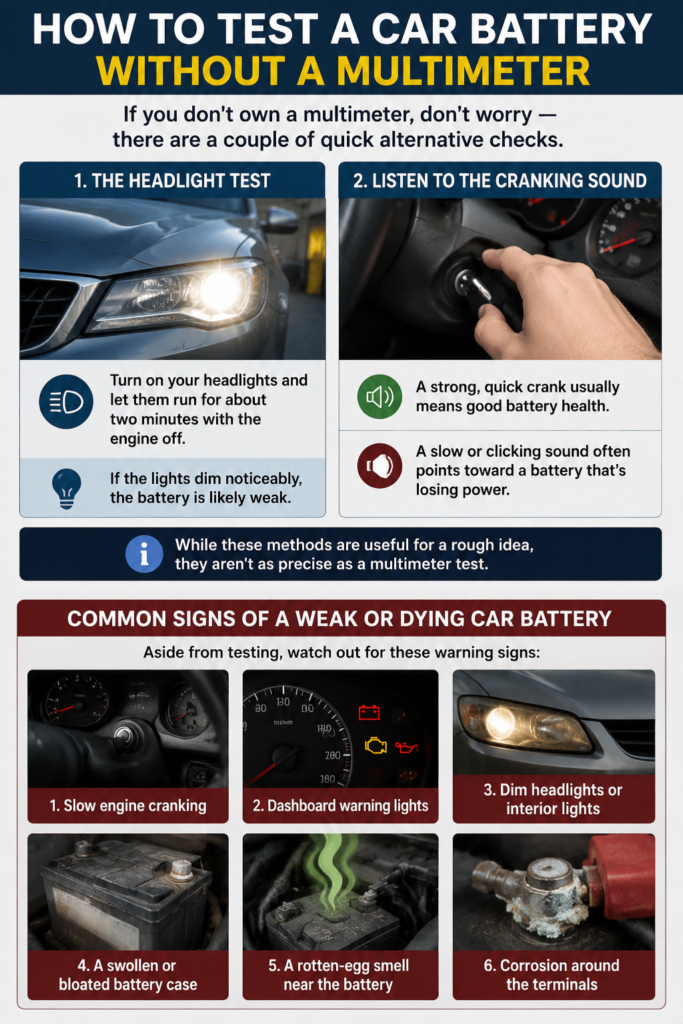
If you don’t own a multimeter, don’t worry — there are a couple of quick alternative checks.
The Headlight Test
Turn on your headlights and let them run for about two minutes with the engine off. If the lights dim noticeably, the battery is likely weak.
Listen to the Cranking Sound
When you turn the key, listen closely. A strong, quick crank usually means good battery health. On the other hand, a slow or clicking sound often points toward a battery that’s losing power.
While these methods are useful for a rough idea, they aren’t as precise as a multimeter test.
Common Signs of a Weak or Dying Car Battery
Aside from testing, watch out for these warning signs:
- Slow engine cranking
- Dashboard warning lights
- Dim headlights or interior lights
- A swollen or bloated battery case
- A rotten-egg smell near the battery
- Corrosion around the terminals
If you notice two or more of these signs, it’s a good idea to test the battery immediately rather than waiting.
How Often Should You Test Your Car Battery?
Generally, experts recommend testing your battery every three to six months, especially before extreme weather seasons. Cold winters and hot summers both put extra strain on batteries, so testing beforehand helps you avoid unexpected failures.
Additionally, if your car sits unused for long periods, checking the battery more frequently is wise since inactivity drains charge over time.
Simple Tips to Extend Your Car Battery’s Life
- Avoid short, frequent trips that prevent full charging
- Keep terminals clean and corrosion-free
- Turn off lights and accessories when the engine is off
- Drive regularly to keep the battery charged
- Park in shaded or covered areas during extreme heat
Alongside battery care, staying on top of other small maintenance tasks keeps your car running efficiently. For instance, learning how to change car air filter is another quick DIY job that improves engine performance and fuel efficiency, much like a healthy battery improves starting reliability.
Frequently Asked Questions
How do I know if my car battery is bad?
Signs include slow cranking, dim lights, dashboard warnings, and a voltage reading below 12.2 volts when tested with a multimeter.
What voltage should a car battery read?
A fully charged, healthy car battery should read between 12.4 and 12.7 volts when the engine is off.
Can I test a car battery without a multimeter?
Yes. You can try the headlight test or listen to the engine’s cranking sound, though these methods are less precise than using a multimeter.
How long does a car battery last?
Most car batteries last between three and five years, depending on climate, driving habits, and maintenance.
Why does my car battery keep dying?
Frequent drainage can result from a faulty alternator, parasitic electrical drains, extreme temperatures, or an aging battery that no longer holds charge well.
Is 12.2 volts a good battery reading?
A reading of 12.2 volts indicates the battery is only about 50% charged. It’s not dead, but it needs charging soon to avoid starting issues.
Final Thoughts
Testing your car battery doesn’t require special skills or expensive tools. With a simple multimeter and a few minutes, you can catch problems early and avoid being stranded with a dead battery. Regular checks, paired with basic maintenance habits, keep your car reliable throughout the year. So, the next time your engine feels sluggish to start, don’t ignore it — grab your multimeter, run a quick test, and take action before a small issue turns into a bigger, costlier one.
About the Author