Automotive Brands: A Complete Guide to the World’s Leading Car Manufacturers, Industry Trends, and Smart Buying Decisions
Introduction
Imagine walking into a dealership with dozens of vehicles on display. Every salesperson claims their brand is the best. Online reviews tell different stories, and friends recommend completely different manufacturers. Choosing among today’s automotive brands can quickly become overwhelming.
The modern automotive industry is more competitive than ever. According to industry reports, more than 90 million vehicles are produced worldwide each year. Consumers now evaluate far more than price. They compare reliability, safety, fuel economy, resale value, electric vehicle technology, warranty coverage, and customer support before making a decision.
Whether you’re buying your first car, upgrading your family vehicle, or researching luxury models, understanding the strengths and weaknesses of major automotive brands can save thousands of dollars and years of frustration.
This guide explains how automotive brands differ, what makes each unique, and how to choose the right manufacturer based on your needs instead of marketing claims.
Executive Summary
This comprehensive guide covers:
- What automotive brands are and why brand reputation matters
- Major global manufacturers and their specialties
- Comparison of luxury, economy, and electric vehicle brands
- Cost analysis of ownership
- Reliability considerations
- Future industry trends
- Honest assessments of leading manufacturers
- Practical buying strategies
- Real-world examples from different buyers
By the end, you’ll understand how to evaluate an automotive brand based on long-term value rather than advertising alone.
What Are Automotive Brands?
An automotive brand represents a vehicle manufacturer’s identity, engineering philosophy, customer experience, and product lineup.
A brand influences how buyers perceive:
- Reliability
- Safety
- Innovation
- Performance
- Luxury
- Technology
- Customer service
- Resale value
While many people use manufacturer and brand interchangeably, they are not always the same.
For example:
| Manufacturer | Automotive Brands |
|---|---|
| Toyota Motor Corporation | Toyota, Lexus |
| Volkswagen Group | Volkswagen, Audi, Porsche, Bentley, Lamborghini, Skoda |
| General Motors | Chevrolet, GMC, Cadillac, Buick |
| Hyundai Motor Group | Hyundai, Kia, Genesis |
Understanding parent companies helps explain why some brands share engines, platforms, or technologies while targeting different audiences.
Why Automotive Brands Matter
Choosing the right automotive brand affects ownership for years.
Major differences include:
Reliability
Reliable brands typically require fewer repairs and lower maintenance costs.
Examples include:
- Toyota
- Honda
- Lexus
Safety
Manufacturers invest differently in safety technology.
Today’s leading brands offer:
- Automatic Emergency Braking
- Lane Keeping Assist
- Blind Spot Monitoring
- Adaptive Cruise Control
Resale Value
Vehicles from trusted brands often lose value more slowly.
Strong resale value reduces the true cost of ownership.
Warranty Coverage
Warranty terms vary significantly.
Some manufacturers provide:
- 3-year basic coverage
- 5-year powertrain protection
- 10-year limited warranties
Long warranties reduce financial risk during ownership.
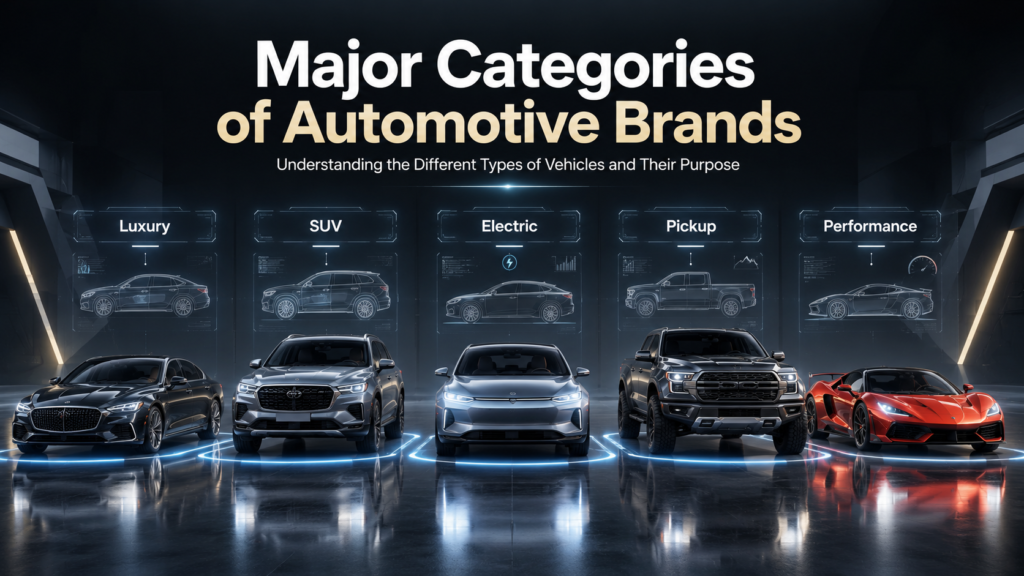
Types of Automotive Brands
Economy Brands
Designed for affordability and efficiency.
Popular examples include:
- Toyota
- Honda
- Hyundai
- Kia
- Nissan
Advantages:
- Lower purchase prices
- Better fuel economy
- Lower maintenance costs
Disadvantages:
- Fewer premium materials
- Less advanced performance features
Luxury Automotive Brands
Luxury manufacturers emphasize comfort, craftsmanship, technology, and performance.
Leading examples include:
- Mercedes-Benz
- BMW
- Audi
- Lexus
- Genesis
Advantages:
- Premium interiors
- Advanced driver assistance
- High-performance engines
- Brand prestige
Drawbacks:
- Higher maintenance
- Expensive repairs
- Faster depreciation for some models
Performance Brands
Performance-focused manufacturers prioritize driving excitement.
Examples:
- Porsche
- Ferrari
- Lamborghini
- McLaren
These vehicles deliver exceptional engineering but require higher ownership budgets.
Electric Vehicle Brands
The EV market has transformed rapidly.
Popular manufacturers include:
- Tesla
- BYD
- Rivian
- Lucid
- Hyundai
Key evaluation factors include:
- Charging speed
- Battery range
- Software updates
- Charging infrastructure
The World’s Leading Automotive Brands
Toyota
Toyota has earned a global reputation for long-term reliability.
Pros
- Excellent durability
- Strong resale value
- Low maintenance costs
- Extensive dealer network
Cons
- Conservative styling
- Limited excitement in some models
Best for:
Families, commuters, and first-time buyers.
Honda
Honda combines reliability with enjoyable driving dynamics.
Strengths include:
- Fuel efficiency
- Engine quality
- Comfortable interiors
- Good resale value
Weaknesses include:
- Road noise in some models
- Limited hybrid availability in certain regions
Ford
Ford remains one of America’s most recognized manufacturers.
Popular strengths include:
- Pickup trucks
- SUVs
- Performance vehicles
Challenges include:
- Mixed reliability across model years
- Higher repair costs on some advanced systems
BMW
BMW emphasizes driving performance.
Advantages:
- Excellent handling
- Powerful engines
- Premium interiors
- Advanced technology
Disadvantages:
- Expensive maintenance
- Costly replacement parts
Mercedes-Benz
Mercedes focuses on luxury, innovation, and comfort.
Strengths:
- Elegant interiors
- Safety leadership
- Advanced driver assistance
Weaknesses:
- Premium ownership costs
- Complex electronics
Hyundai
Hyundai has dramatically improved over the last decade.
Today’s vehicles offer:
- Competitive pricing
- Long warranties
- Modern technology
- Attractive styling
Kia
Kia shares many components with Hyundai while developing its own identity.
Advantages:
- Affordable pricing
- Excellent warranties
- Modern interiors
Potential drawbacks:
- Lower resale value than Toyota
Tesla
Tesla revolutionized electric vehicles.
Strengths:
- Long driving range
- Fast charging
- Software updates
- Performance
Weaknesses:
- Service availability varies
- Interior quality opinions differ among buyers

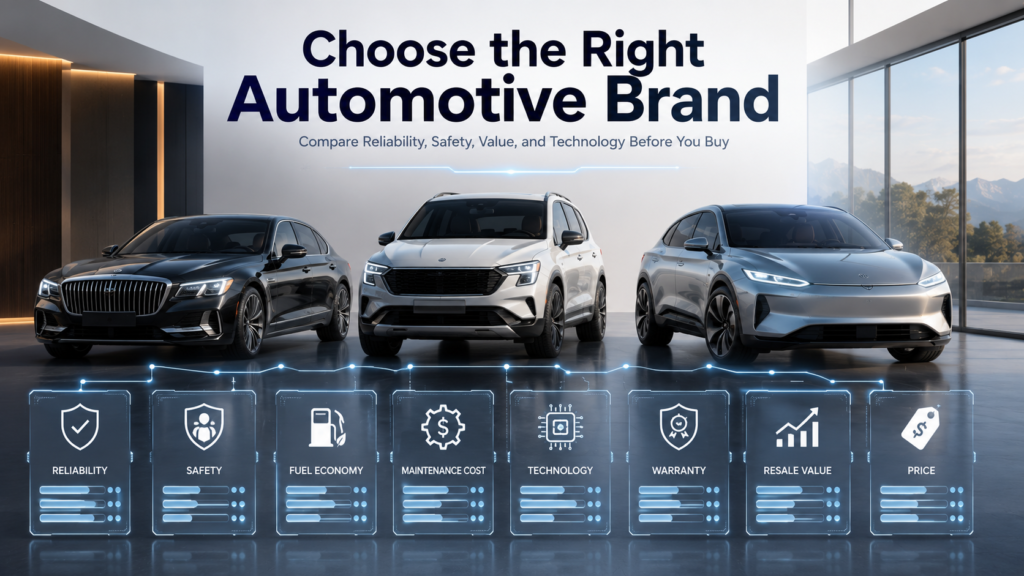
How to Compare Automotive Brands
Before buying, compare the following categories.
| Category | Why It Matters |
|---|---|
| Reliability | Reduces repair costs |
| Safety | Protects passengers |
| Fuel Economy | Saves money |
| Warranty | Lowers ownership risk |
| Technology | Improves convenience |
| Resale Value | Protects investment |
| Maintenance Costs | Impacts long-term expenses |
| Dealer Network | Simplifies servicing |
Cost of Ownership
Many buyers focus only on purchase price.
Experienced owners evaluate total ownership cost.
Major expenses include:
- Purchase price
- Insurance
- Fuel
- Maintenance
- Repairs
- Taxes
- Registration
- Depreciation
A vehicle with a higher purchase price may cost less over ten years if maintenance and depreciation remain low.
Common Mistakes When Choosing Automotive Brands
Buying Based Only on Appearance
A stylish vehicle does not guarantee reliability.
Research ownership costs before purchasing.
Ignoring Maintenance Costs
Luxury vehicles often require premium parts and specialized service.
Budget accordingly.
Forgetting Resale Value
Depreciation affects total ownership cost more than many buyers realize.
Overlooking Safety Ratings
Always compare independent crash test results alongside manufacturer claims.
Best Practices for Choosing the Right Brand
Define Your Needs
Ask yourself:
- Daily commuting?
- Family transportation?
- Off-road driving?
- Long-distance travel?
- Business use?
Different needs require different manufacturers.
Set a Realistic Budget
Include:
- Insurance
- Fuel
- Maintenance
- Financing
- Registration
Never budget only for the sticker price.
Research Reliability
Read long-term ownership reviews rather than only launch reviews.
Vehicles often perform differently after several years of use.
Test Drive Multiple Models
Specifications rarely replace real driving experience.
Comfort, visibility, seating position, and controls vary greatly between manufacturers.
Real-World Case Studies: Lessons from Different Buyers
One of the best ways to understand automotive brands is by looking at real ownership experiences. The following case studies are based on common buying scenarios and reflect outcomes reported by many vehicle owners.
Case Study 1: A Family Prioritizes Reliability
Problem
A family of five needed a midsize SUV for daily commuting, school runs, and annual road trips. Their previous vehicle required frequent repairs after only six years.
Strategy
They compared several brands, including Toyota, Honda, Hyundai, and Ford. Their focus was long-term reliability, fuel efficiency, and resale value rather than luxury features.
Execution
After test-driving multiple models and reviewing maintenance records, they selected a Toyota SUV with a hybrid powertrain.
Results
- Fuel costs dropped by approximately 30%.
- No unexpected repairs occurred during the first three years.
- The vehicle maintained excellent resale value.
Lesson Learned
Choosing a dependable brand often reduces total ownership costs more than choosing the lowest purchase price.
Case Study 2: A Young Professional Buys an Electric Vehicle
Problem
A city commuter wanted to eliminate fuel expenses while reducing environmental impact.
Strategy
The buyer compared Tesla, Hyundai, Kia, and BYD based on charging infrastructure, driving range, and software support.
Execution
After evaluating local charging availability, they selected a Tesla Model 3.
Results
- Fuel expenses were replaced by lower electricity costs.
- Over-the-air software updates added new features.
- Maintenance requirements were significantly lower than their previous gasoline sedan.
Lesson Learned
Electric vehicles work best when charging options are convenient and daily driving habits match the vehicle’s range.
Case Study 3: Small Business Fleet Upgrade
Problem
A delivery company needed reliable commercial vehicles with predictable maintenance costs.
Strategy
The business compared Ford, Toyota, Mercedes-Benz, and Hyundai commercial vehicles.
Execution
After reviewing maintenance histories and operating costs, the company selected a combination of Toyota and Ford models.
Results
- Fleet downtime decreased.
- Repair costs became more predictable.
- Driver satisfaction improved because of updated safety features.
Lesson Learned
Fleet buyers benefit more from reliability and service availability than premium features.
Case Study 4: Luxury Buyer Focuses on Comfort
Problem
An executive wanted a premium sedan with advanced technology and exceptional comfort.
Strategy
BMW, Mercedes-Benz, Audi, and Lexus were evaluated.
Execution
Multiple test drives highlighted differences in ride quality, infotainment systems, and maintenance expectations.
Results
The buyer selected a Lexus because it balanced luxury with lower long-term maintenance costs.
Lesson Learned
Luxury ownership is not only about prestige. Long-term ownership expenses deserve equal attention.
Honest Reviews of Leading Automotive Brands
Toyota
Pros
- Outstanding reliability
- Excellent resale value
- Strong hybrid lineup
- Wide dealer network
Cons
- Conservative styling
- Performance models are limited
Best Use Case
Drivers looking for dependable transportation with low ownership costs.
Honda
Pros
- Efficient engines
- Comfortable interiors
- Reliable powertrains
- Strong resale value
Cons
- Some models can experience road noise.
- Premium features may require higher trims.
Best Use Case
Commuters and families who value efficiency and durability.
Hyundai
Pros
- Excellent warranty
- Competitive pricing
- Modern technology
- Attractive design
Cons
- Resale value still trails some Japanese competitors.
Best Use Case
Buyers seeking strong value and modern features.
Kia
Pros
- Affordable pricing
- Feature-rich interiors
- Long warranty coverage
Cons
- Brand perception continues to evolve in some markets.
Best Use Case
First-time buyers and growing families.
Ford
Pros
- Industry-leading pickup trucks
- Strong SUV lineup
- Good towing capability
Cons
- Reliability varies between models.
- Maintenance costs can increase with advanced features.
Best Use Case
Truck owners and outdoor enthusiasts.
BMW
Pros
- Exceptional handling
- Powerful engines
- Premium interiors
- Innovative technology
Cons
- High maintenance expenses
- Premium repair costs
Best Use Case
Drivers who prioritize performance and driving engagement.
Common Buying Mistakes
Even experienced buyers make avoidable mistakes when comparing automotive brands.
- Choosing a vehicle based only on monthly payments.
- Ignoring insurance costs.
- Skipping a thorough test drive.
- Overlooking maintenance schedules.
- Buying features that will rarely be used.
- Failing to research long-term reliability.
- Ignoring resale value projections.
Avoiding these mistakes can save thousands of dollars over the life of a vehicle.
Expert Tips for Choosing the Right Brand
- Define your budget before visiting dealerships.
- Compare total ownership costs instead of sticker prices.
- Read long-term owner reviews rather than relying only on advertisements.
- Check independent safety ratings.
- Verify warranty coverage.
- Research local dealership service quality.
- Consider future resale value.
- Think about how your needs may change over the next five to ten years.
Industry Trends Shaping Automotive Brands
The automotive industry continues to evolve rapidly.
Some of the most important trends include:
Increased Electrification
Manufacturers are expanding electric vehicle lineups while improving battery technology and charging speed.
Connected Vehicles
Modern cars receive software updates, offer smartphone integration, and provide advanced navigation services.
Advanced Driver Assistance Systems
Safety technologies continue to improve through features such as adaptive cruise control, lane-centering assistance, and automated emergency braking.
Sustainable Manufacturing
Many leading automotive brands are investing in recycled materials, renewable energy, and lower-emission production processes.
Artificial Intelligence
AI is improving predictive maintenance, voice assistants, navigation, and autonomous driving research.

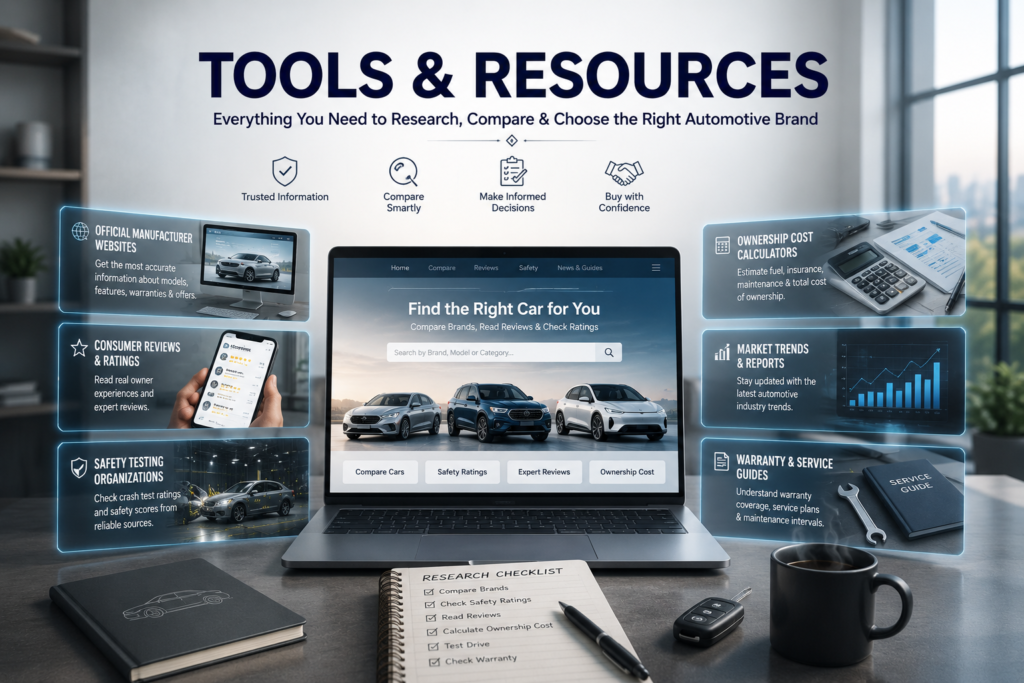
Tools and Resources
The right tools help you compare cars before you buy.
1. Kelley Blue Book
Pros
- Trusted car values
- Easy price checks
- Good buying guides
Cons
- Prices may vary by area
Best For
Used car buyers.
2. Edmunds
Pros
- Deep reviews
- Real owner feedback
- Cost to own data
Cons
- Some data focus on the U.S.
Best For
New car research.
3. Carfax
Pros
- Vehicle history
- Accident records
- Service reports
Cons
- Paid reports
Best For
Used vehicles.
4. Consumer Reports
Pros
- Reliability scores
- Owner surveys
- Safety reviews
Cons
- Paid access
Best For
Long-term research.
5. IIHS
Pros
- Crash tests
- Safety ratings
Cons
- Not every model tested
Best For
Safety checks.
6. NHTSA
Pros
- Government safety data
- Recall notices
Cons
- Less detail than some reviews
Best For
Safety research.
7. AutoTrader
Pros
- Large car list
- Easy search
Cons
- Prices vary by seller
Best For
Finding new and used cars.
Common Problems and Simple Fixes
High Repair Bills
Cause
Luxury parts cost more.
Fix
Check service costs before you buy.
Poor Fuel Use
Cause
Wrong driving style or poor care.
Fix
Keep tires full and service the car on time.
Hard to Find Parts
Cause
Rare models may need special parts.
Fix
Choose brands with a large dealer network.
Internal Link Ideas
If this article is on your website, link it with pages like:
- Best Family Cars
- Best Electric Cars
- SUV Buying Guide
- Sedan vs SUV
- Hybrid Cars Guide
- Car Safety Tips
- Car Loan Guide
- Used Car Checklist
- Best Luxury Cars
- Car Insurance Tips
- Car Care Guide
- Winter Driving Tips
- Summer Car Care
- Best Pickup Trucks
- EV Charging Guide
Helpful External Resources
These trusted sites can help you learn more.
- Kelley Blue Book
- Consumer Reports
- National Highway Traffic Safety Administration (NHTSA)
Frequently Asked Questions
1. Which automotive brand is the most reliable?
Toyota and Honda are often seen as the most reliable brands because they have low repair rates and strong resale value.
2. Which brand has the best luxury cars?
Mercedes-Benz, BMW, Lexus, and Audi all offer high-end cars with great comfort and new tech.
3. Which car brand costs the least to own?
Toyota and Hyundai usually have lower repair and service costs.
4. Are electric cars cheaper to own?
In many cases, yes. They need less service and use less energy than gas cars.
5. Which brand has the best warranty?
Hyundai and Kia offer some of the longest factory warranties.
6. Is resale value important?
Yes. A car with high resale value can save you a lot of money when you sell or trade it.
7. Should I buy a new or used car?
It depends on your budget. New cars have full warranties. Used cars often cost less.
8. What should I check before buying?
Look at safety, repair cost, fuel use, warranty, and owner reviews.
9. Which brand is best for first-time buyers?
Toyota, Honda, Hyundai, and Kia are all good choices.
10. How often should I service my car?
Follow the service plan in your owner’s manual. Regular service helps avoid costly repairs.
Key Takeaways
- Automotive brands are not all the same.
- Think about long-term costs, not just the sale price.
- Safety and reliability should come first.
- Read owner reviews before you buy.
- Compare more than one brand.
- Test drive every car you like.
- Look at fuel cost, repair cost, and resale value.
- Buy the car that fits your real needs.
Conclusion
The world of automotive brands keeps changing. New tech, electric cars, and smart safety tools give buyers more choices than ever before. While every brand has good and bad points, the best choice depends on your budget, driving style, and long-term plans.
Do your research, compare real costs, and take time to test drive different models. A careful choice today can save money and stress for many years.
The best car is not always the most costly or the fastest. It is the one that meets your needs, keeps you safe, and gives you good value over time.
As new models arrive each year, one question remains: Which automotive brand will give you the best value for your next journey?