Introduction
Suppose. You wake up on a sunny weekend and want a quick ride to the local café. Instead of starting your car, waiting for the engine to warm up, and searching for parking, you hop onto an electric mini bike motorcycle. Within seconds, you’re gliding through quiet streets with almost no noise, zero fuel costs, and a smile on your face.
This simple experience explains why electric mini bikes have become one of the fastest-growing personal transportation options. They are compact, affordable, easy to maintain, and surprisingly fun to ride. Whether you’re a beginner, a commuter, or an outdoor enthusiast, these small electric motorcycles offer a practical alternative to traditional gas-powered bikes.
According to industry reports, the global electric motorcycle and scooter market continues to expand as battery technology improves and cities encourage cleaner transportation. Better lithium-ion batteries, faster charging, and stronger electric motors have made modern mini bikes more capable than ever.
Still, choosing the right model isn’t easy. Hundreds of brands promise the best performance, longest range, and highest speed. Some live up to those claims, while others disappoint buyers after only a few months.
This guide explains everything you need to know before buying an electric mini bike motorcycle. You’ll learn how they work, what features matter most, which riders benefit the most, and how to avoid expensive mistakes.
By the end, you’ll have the confidence to choose a model that fits your riding style, budget, and long-term goals.
Executive Summary
If you’re short on time, here’s what you should know.
- Electric mini bike motorcycles combine the excitement of motorcycles with the simplicity of electric power.
- They require significantly less maintenance than gas-powered mini bikes.
- Most modern models use lithium-ion batteries for longer range and faster charging.
- The best choice depends on your intended use rather than top speed alone.
- Battery quality matters more than motor power in long-term ownership.
- Premium brands usually provide better reliability, replacement parts, and customer support.
- Charging costs are much lower than gasoline expenses.
- Riders should always prioritize safety gear over performance upgrades.
- Proper battery care can extend lifespan by several years.
- Regular inspections improve both performance and safety.
Throughout this guide, you’ll also discover real-world experiences, expert buying tips, cost comparisons, maintenance advice, and future trends shaping the electric mini bike industry.
What Is an Electric Mini Bike Motorcycle?
An electric mini bike motorcycle is a compact two-wheeled vehicle powered by an electric motor instead of a gasoline engine. It combines motorcycle-inspired styling with a lightweight frame, rechargeable battery, and simple controls.
Unlike traditional motorcycles, electric mini bikes are designed for convenience. They produce instant torque, require minimal maintenance, and operate quietly.
Many riders use them for:
- Neighborhood transportation
- Short-distance commuting
- Recreational riding
- Campgrounds
- Private property
- Farm use
- Light trail riding
- Urban travel
Their compact size makes storage easier, especially for people living in apartments or homes with limited garage space.
How Does an Electric Mini Bike Motorcycle Work?
Understanding the basic technology helps you make smarter buying decisions.
Battery Pack
The battery stores electrical energy.
Most premium bikes use lithium-ion batteries because they offer:
- Longer lifespan
- Faster charging
- Lower weight
- Higher efficiency
- Better energy density
Budget models may still use lead-acid batteries, but these are heavier and require more maintenance.
Electric Motor
Instead of burning fuel, the motor converts electrical energy into motion.
Popular motor types include:
- Hub motors
- Mid-drive motors
- Brushless DC motors
Brushless motors are generally preferred because they produce less heat and last longer.
Controller
The controller acts as the bike’s brain.
It regulates:
- Speed
- Power delivery
- Acceleration
- Battery protection
- Motor efficiency
A high-quality controller creates smoother acceleration and better riding comfort.
Throttle System
Most electric mini bikes use a twist throttle similar to traditional motorcycles.
When you rotate the throttle:
- A signal reaches the controller.
- The controller supplies power.
- The motor spins.
- The bike accelerates.
The response feels immediate because electric motors produce maximum torque almost instantly.
Braking System
Most models include:
- Disc brakes
- Hydraulic brakes
- Regenerative braking (on select models)
Hydraulic disc brakes provide stronger stopping power and require less hand effort.
Why Are Electric Mini Bike Motorcycles Becoming So Popular?
Several trends are driving their popularity.
Lower Operating Costs
Electricity costs much less than gasoline.
For many riders, charging a battery costs only a small fraction of a fuel tank.
Over several years, these savings become significant.
Quiet Operation
Traditional mini bikes can be loud.
Electric versions operate almost silently.
This makes them ideal for neighborhoods where excessive noise may disturb others.
Easy Maintenance
Gas-powered bikes require:
- Oil changes
- Spark plugs
- Carburetor cleaning
- Fuel filters
- Air filters
- Engine tuning
An electric mini bike motorcycle eliminates most of these maintenance tasks.
Instant Acceleration
Electric motors produce full torque immediately.
This makes acceleration smooth, predictable, and enjoyable, especially in city riding.
Eco-Friendly Transportation
Electric bikes produce no tailpipe emissions.
While electricity generation varies by region, electric transportation generally reduces local air pollution and supports cleaner urban environments.
Key Features to Look For
Not every electric mini bike offers the same performance.
Here are the most important features to evaluate.
Battery Capacity
Battery size determines how far you can ride.
Higher-capacity batteries usually deliver:
- Longer range
- Better consistency
- Less frequent charging
However, they also increase purchase price.
Motor Power
Motor power is measured in watts.
Common ratings include:
| Motor Size | Best For |
|---|---|
| 250W | Kids and beginners |
| 500W | Casual riders |
| 750W | Daily commuting |
| 1000W | Off-road riding |
| 2000W+ | High-performance enthusiasts |
Motor size alone doesn’t determine performance.
Battery voltage, controller quality, and rider weight also matter.
Top Speed
Most electric mini bikes reach speeds between:
- 15 mph
- 25 mph
- 35 mph
- 45+ mph
Choose a speed that matches your riding environment rather than chasing the highest number.
Riding Range
Manufacturers often advertise ideal conditions.
Real-world range depends on:
- Rider weight
- Terrain
- Tire pressure
- Temperature
- Riding style
- Wind conditions
Expect slightly lower range than official estimates.
Tires
Wide tires improve:
- Stability
- Comfort
- Off-road traction
- Cornering confidence
Street tires provide better efficiency, while knobby tires excel on dirt and gravel.
Weight Capacity
Every bike has a maximum rider limit.
Exceeding this limit reduces:
- Performance
- Battery range
- Brake efficiency
- Component lifespan
Always choose a model that comfortably supports your weight.
Who Should Buy an Electric Mini Bike Motorcycle?
These bikes are a great fit for:
- Daily commuters with short travel distances
- Students looking for affordable transportation
- Outdoor enthusiasts exploring trails
- Campground and RV travelers
- Homeowners with large properties
- Farmers and ranch workers
- Delivery riders in suitable areas
- Beginners entering the world of electric motorcycles
The ideal rider values simplicity, low operating costs, and enjoyable everyday mobility.
Step 1: Define Your Riding Purpose
Different riders have different needs.
| Riding Purpose | Recommended Features |
|---|---|
| Daily commuting | Long battery range, comfortable seat |
| Weekend recreation | Good suspension, wider tires |
| Off-road trails | Powerful motor, knobby tires |
| Farm or ranch use | High torque, durable frame |
| Camping and RV trips | Lightweight, portable design |
| Teen beginners | Moderate speed, easy controls |
Buying a bike designed for your primary use leads to a better ownership experience.
Step 2: Set a Realistic Budget
Many buyers focus only on the purchase price.
Instead, consider the total cost of ownership.
Typical price ranges include:
| Price Range | What You Get |
|---|---|
| Under $500 | Entry-level models with limited range |
| $500–$900 | Better batteries and improved build quality |
| $900–$1,500 | Strong performance and reliable components |
| $1,500–$3,000 | Premium features, longer range, advanced suspension |
| $3,000+ | High-end electric mini motorcycles with exceptional performance |
Spending slightly more often reduces maintenance costs over time.
Step 3: Compare Battery Options
The battery is the most valuable part of the bike.
Lithium-Ion Batteries
Advantages:
- Longer lifespan
- Lightweight
- Faster charging
- Better efficiency
- Higher resale value
Disadvantages:
- Higher initial cost
Lead-Acid Batteries
Advantages:
- Lower purchase price
Disadvantages:
- Heavy
- Short lifespan
- Slower charging
- Lower efficiency
Most experienced riders recommend lithium-ion batteries despite the higher upfront investment.
Step 4: Understand Motor Power
Many advertisements highlight wattage.
However, motor power is only part of the story.
A well-designed 750W bike may outperform a poorly built 1000W model.
Consider:
- Battery voltage
- Controller quality
- Tire size
- Rider weight
- Terrain
Together, these factors determine real-world performance
Cost of Owning an Electric Mini Bike Motorcycle
Owning an electric bike is generally affordable.
Here is a typical annual cost estimate.
| Expense | Estimated Annual Cost |
|---|---|
| Electricity | $30–$120 |
| Tire replacement | $60–$180 |
| Brake pads | $30–$80 |
| Battery maintenance | Minimal |
| General servicing | $50–$150 |
| Accessories | Optional |
Compared with gasoline motorcycles, fuel savings can be significant.
Common Buying Mistakes
Buying Only Based on Speed
Many first-time buyers focus on top speed.
However, range, comfort, and reliability often matter more for everyday use.
Ignoring Battery Quality
A cheap battery may reduce performance and require replacement sooner.
Research battery specifications before buying.
Forgetting Rider Weight
Heavier riders may experience:
- Reduced acceleration
- Shorter range
- Lower top speed
Choose a model that comfortably supports your weight.
Choosing Unknown Brands
Low-cost brands sometimes offer limited customer support and spare parts.
Check reviews and warranty details before purchasing.
Skipping Safety Gear
Never spend your full budget on the bike alone.
Always include:
- Helmet
- Gloves
- Protective clothing
- Reflective gear
Safety should come first..
Case Study 1: Urban Commuter
Problem
Sarah, a graphic designer, drove 8 miles each way to work. Fuel and parking costs were increasing.
Strategy
She purchased a mid-range electric mini bike motorcycle with a 35-mile estimated range.
Execution
She charged it overnight and used it for weekday commuting.
Results
- Monthly fuel expenses dropped significantly.
- Parking became much easier.
- Her commute time decreased during heavy traffic.
Lesson Learned
For short city trips, range and comfort were more valuable than maximum speed.
Case Study 2: Weekend Trail Rider
Problem
David wanted a quiet bike for recreational trail riding without the maintenance of a gas engine.
Strategy
He chose a model with wider tires and upgraded suspension.
Execution
He rode on maintained off-road trails and cleaned the bike after each outing.
Results
- Consistent performance over several months.
- Minimal maintenance.
- Improved confidence on uneven terrain.
Lesson Learned
Suspension quality had a bigger impact on comfort than expected.
Case Study 3: College Student
Problem
A university student needed affordable transportation between campus, housing, and nearby stores.
Strategy
She selected an entry-level lithium-ion model with moderate speed and reliable brakes.
Execution
Daily trips were planned within the bike’s practical range, with overnight charging.
Results
- Lower transportation costs than using ride-sharing services.
- Easy parking around campus.
- Convenient daily travel.
Lesson Learned
Matching the bike to actual travel needs provided better value than buying a higher-powered model.
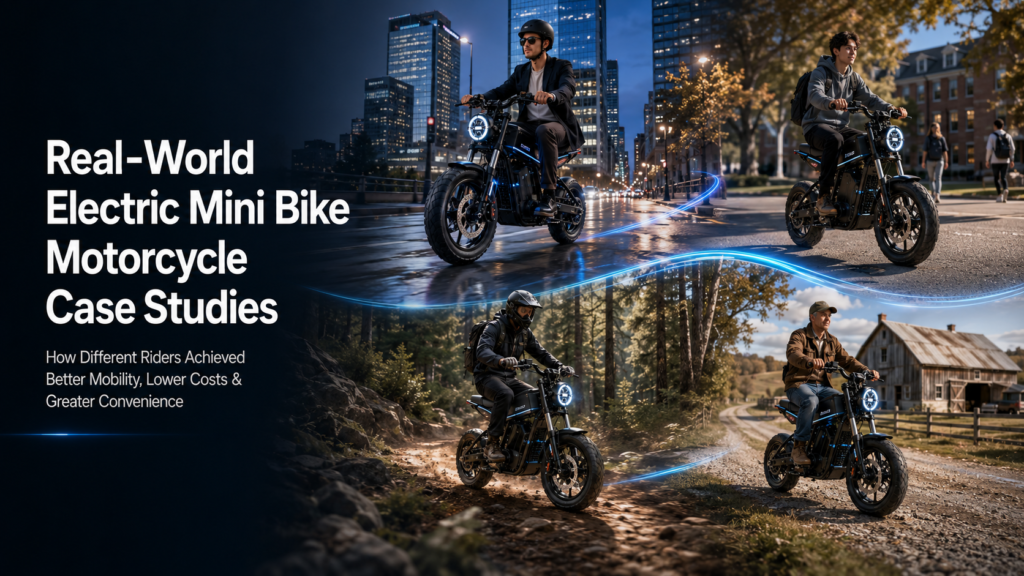
Case Study 4: Rural Property Owner
Problem
Michael owned several acres and needed a quick way to move around the property.
Strategy
He chose a higher-torque model designed for light off-road use.
Execution
The bike was used for routine inspections and transporting small tools.
Results
- Reduced reliance on a larger utility vehicle for short trips.
- Lower operating costs.
- Quieter operation around livestock.
Lesson Learned
Torque and durability mattered more than top speed for property work.
Industry Trends to Watch
The electric mini bike motorcycle market continues to evolve.
Current trends include:
- Higher-capacity lithium-ion batteries
- Faster charging technology
- Improved battery management systems
- Lightweight aluminum frames
- Better regenerative braking
- Smartphone connectivity on premium models
- More efficient brushless motors
- Enhanced rider safety features
These developments are making electric mini bikes more practical and appealing for a wider range of riders.
Best Electric Mini Bike Motorcycle Brands and Tools
Choosing the right brand is just as important as choosing the right specifications. Below are some of the most trusted manufacturers and helpful tools for buyers.
1. Razor
Best For: Beginners and teenagers
Pros
- Affordable pricing
- Easy to ride
- Widely available
- Good replacement parts
Cons
- Limited range
- Lower top speed
- Basic suspension
Typical Price
$350–$700
Ideal Buyer
First-time riders looking for recreational use.
2. Segway
Best For: Daily commuting
Pros
- Excellent build quality
- Smart technology features
- Reliable battery systems
- Comfortable ride
Cons
- Higher price
- Premium accessories cost extra
Typical Price
$900–$2,500
Ideal Buyer
Urban commuters who want reliability.
3. MotoTec
Best For: Off-road fun
Pros
- Strong motors
- Good suspension
- Durable frames
- Wide tire options
Cons
- Heavier than some competitors
- Charging takes longer on older models
Typical Price
$800–$2,000
Ideal Buyer
Trail riders and outdoor enthusiasts.
4. Coleman
Best For: Recreational riding
Pros
- Comfortable seating
- Rugged design
- Easy maintenance
Cons
- Fewer electric models
- Limited premium features
Typical Price
$700–$1,500
Ideal Buyer
Weekend riders.
5. Burromax
Best For: Performance-oriented riders
Pros
- Strong acceleration
- Premium components
- High-quality suspension
Cons
- Higher purchase price
Typical Price
$2,000–$4,000
Ideal Buyer
Experienced riders seeking better performance.
6. Hiboy
Best For: Budget-conscious buyers
Pros
- Affordable
- Lightweight
- Simple controls
Cons
- Moderate range
- Smaller battery capacity
Typical Price
$500–$1,200
7. Sur-Ron
Best For: Serious off-road riding
Pros
- Outstanding power
- Excellent suspension
- High-quality battery
- Strong aftermarket support
Cons
- Expensive
- May exceed legal limits in some areas
Typical Price
$3,500–$5,500
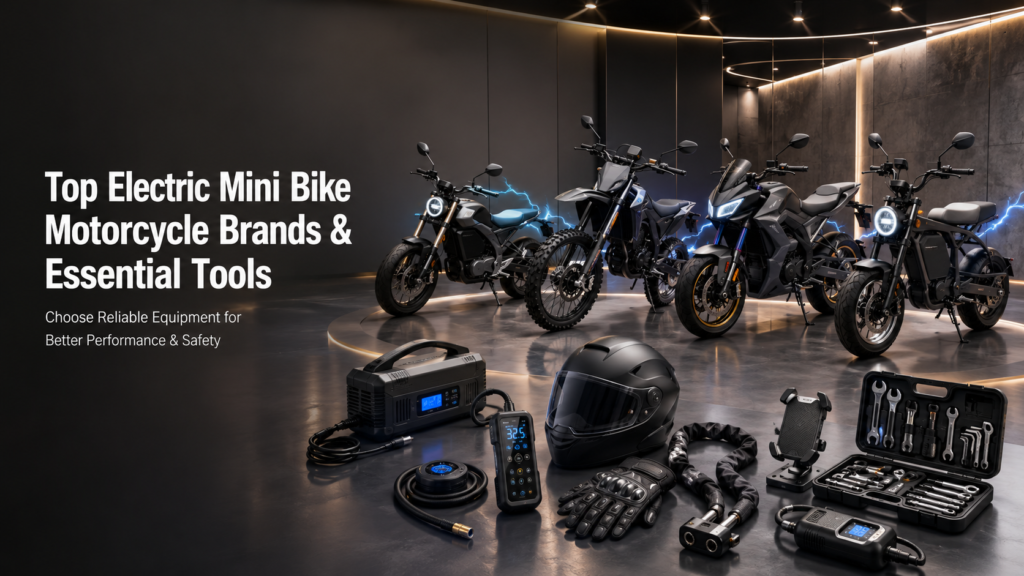
Essential Accessories
Every rider should consider these accessories:
| Accessory | Importance |
|---|---|
| Helmet | Essential |
| Gloves | Essential |
| Knee guards | Recommended |
| Phone mount | Useful |
| Portable air pump | Useful |
| Tire repair kit | Recommended |
| Chain lubricant (if applicable) | Helpful |
| Waterproof cover | Recommended |
| Heavy-duty lock | Essential |
| LED lights | Safety improvement |
Future of the Electric Mini Bike motorcycle
The next five years are expected to bring significant improvements.
Manufacturers are investing in:
- Solid-state battery research
- Faster charging systems
- Smarter battery management
- Lightweight composite frames
- AI-assisted diagnostics
- Improved regenerative braking
- Connected mobile apps
- Enhanced rider safety technology
These innovations should increase range, reduce charging time, and improve reliability.
Frequently Asked Questions (FAQ)
1. How fast can an electric mini bike motorcycle go?
Most models reach between 15 and 45 mph, while high-performance versions may exceed 60 mph.
2. How long does the battery last?
A quality lithium-ion battery typically lasts 3 to 7 years, depending on usage and maintenance.
3. How long does charging take?
Most batteries require 4 to 8 hours for a full charge.
4. Are electric mini bikes waterproof?
Most are water-resistant, not fully waterproof. Avoid riding through deep water or pressure washing electrical components.
5. Do electric mini bikes require oil changes?
No. Electric motors do not require engine oil.
6. Can they climb hills?
Yes. Hill-climbing ability depends on motor power, battery output, rider weight, and gradient.
7. Are they suitable for beginners?
Yes. Many models are easy to operate because they do not require manual gear shifting or a clutch.
8. How much does it cost to charge one?
Charging is generally inexpensive, often costing only a small amount per full charge, depending on local electricity rates.
9. Is electric mini bike motorcycle maintenance expensive?
No. Maintenance costs are usually much lower than those of gas-powered motorcycles because there are fewer moving engine parts.
10. Is an electric mini bike motorcycle worth buying?
For riders who want affordable transportation, low maintenance, quiet operation, and enjoyable short-distance travel, it can be an excellent investment.
Conclusion
The electric mini bike motorcycle has evolved into much more than a recreational vehicle. It offers an efficient, practical, and enjoyable way to travel while reducing fuel costs and maintenance.
Throughout this guide, we’ve explored how these bikes work, what features matter most, how much they cost to own, and how to avoid common buying mistakes. We’ve also compared leading brands, shared real-world case studies, and outlined best practices for long-term ownership.
The most important takeaway is that the right bike isn’t necessarily the fastest or the most expensive. It’s the one that matches your daily needs, riding style, and budget. Focusing on battery quality, reliable brakes, rider comfort, and dependable customer support will provide a better ownership experience than chasing top-speed figures alone.
As battery technology, charging systems, and smart features continue to improve, electric mini bikes are likely to become even more capable and accessible. Whether you’re commuting through city streets, exploring local trails, or simply looking for a fun weekend ride, there’s never been a better time to consider one.
About the Author