How Much Does a Timing Belt Replacement Cost in 2026? Prices, Signs, and What Happens If It Breaks for US Drivers

Your timing belt is one of the hardest working parts in your engine, and also one of the easiest to forget. It is a reinforced rubber belt that keeps your crankshaft and camshaft turning in perfect sync. When it wears out, the damage can go from a routine maintenance bill to a ruined engine in seconds. That is why every car owner in the US should know what a timing belt replacement costs in 2026, when to do it, and what happens if you wait too long.
How Much Does a Timing Belt Replacement Cost in 2026?
For most cars in the United States, a timing belt replacement costs between $500 and $1,000 in 2026. The final bill depends on your vehicle, your engine layout, and whether you use a dealership or an independent shop. Labor makes up most of the cost, because reaching the belt means removing several covers, belts, and sometimes the engine mount.
| Vehicle type | Parts | Labor | Typical total |
|---|---|---|---|
| Compact sedan (Honda Civic, Toyota Corolla) | $150 to $250 | $250 to $450 | $400 to $700 |
| Midsize sedan or SUV (Honda Accord, Toyota RAV4) | $180 to $300 | $350 to $550 | $550 to $900 |
| Full-size truck or large SUV (Ford F-150, Chevy Tahoe) | $200 to $350 | $450 to $700 | $700 to $1,100 |
| Luxury or European car (BMW, Audi, VW) | $300 to $500 | $600 to $1,000 | $900 to $1,500 |
| Adding a water pump at the same time | $80 to $150 extra | Little or no extra labor | $150 to $300 extra |
Most independent shops charge $100 to $150 per hour for labor, while dealerships charge $150 to $200 per hour. The job usually takes 3 to 5 hours. On some engines, especially transverse mounted V6 engines, access is tight and the job can take a full day.
What Is Included in the Price?
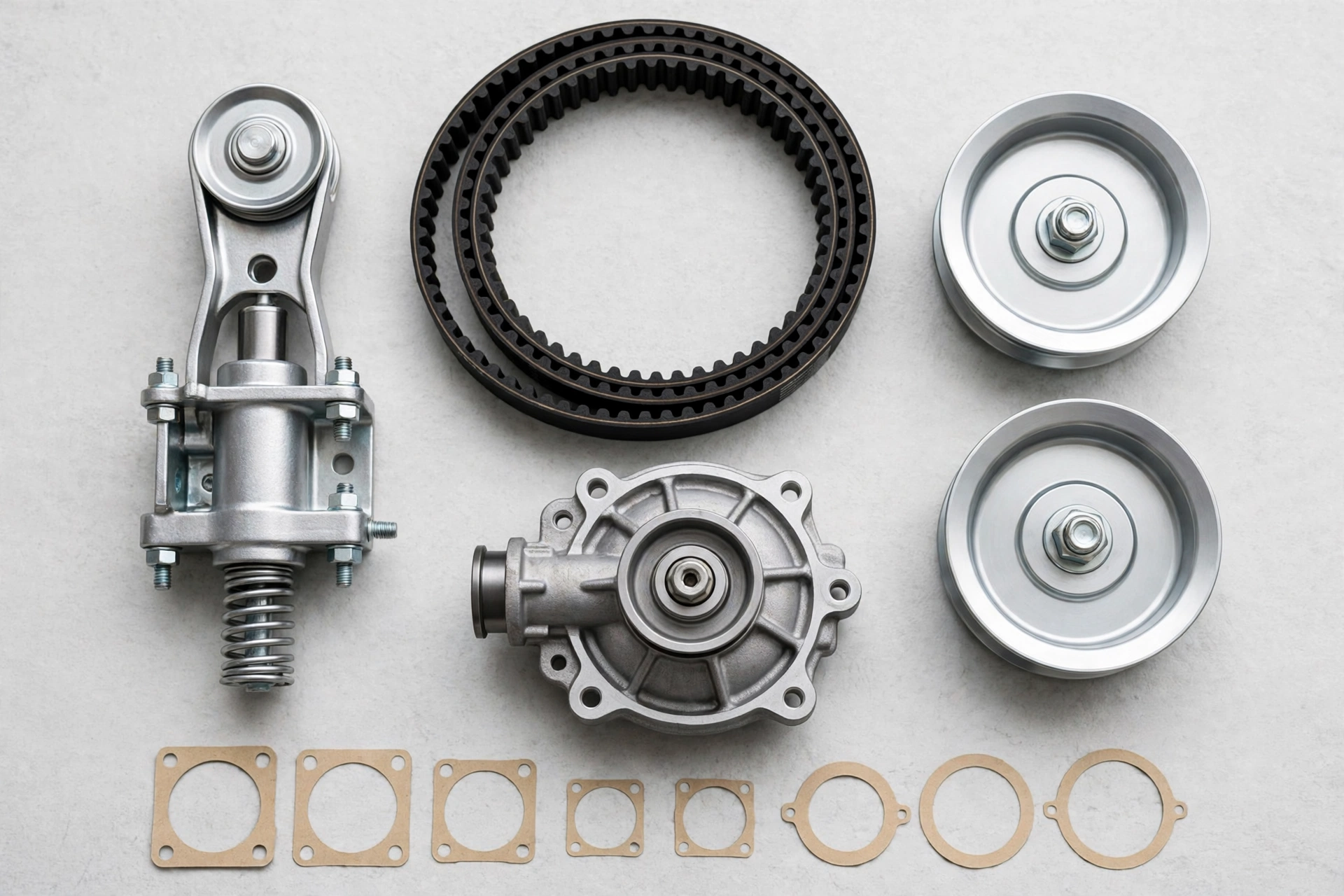
A proper timing belt job is more than a single belt. A good shop will replace the whole timing system while it is apart, because every part in there wears at the same rate. A complete timing belt kit usually includes the timing belt itself, the belt tensioner, idler pulleys, and the camshaft and crankshaft seals. Many mechanics also recommend replacing the water pump during the same job, since it sits behind the timing cover and is driven by the same belt on many engines.
Here is what a typical parts bill looks like:
- Timing belt: $50 to $150
- Tensioner and idler pulleys: $60 to $150
- Water pump: $80 to $150
- Camshaft and crankshaft seals: $20 to $50
- Coolant (refilled after the pump swap): $20 to $40
If a shop quotes you only the belt and skips the tensioner and pulleys, ask why. A worn tensioner can let a brand new belt slip or snap, and you would pay the full labor bill a second time.
Signs Your Timing Belt Needs Replacing
Timing belts rarely fail without warning. Your car usually gives you several clues first. Watch for these signs:
- A ticking noise from the engine. A worn belt or a failing tensioner can make a steady ticking sound that rises with engine speed.
- Engine misfires. If the belt has stretched or a tooth has slipped, the valves open at the wrong time and the engine misfires, especially under load.
- Oil leaking from the front of the engine. A worn timing cover seal can leak oil onto the belt, which softens the rubber and shortens its life.
- Rough idling or trouble starting. A belt that has lost teeth can throw the timing off just enough to make the engine run rough or refuse to start.
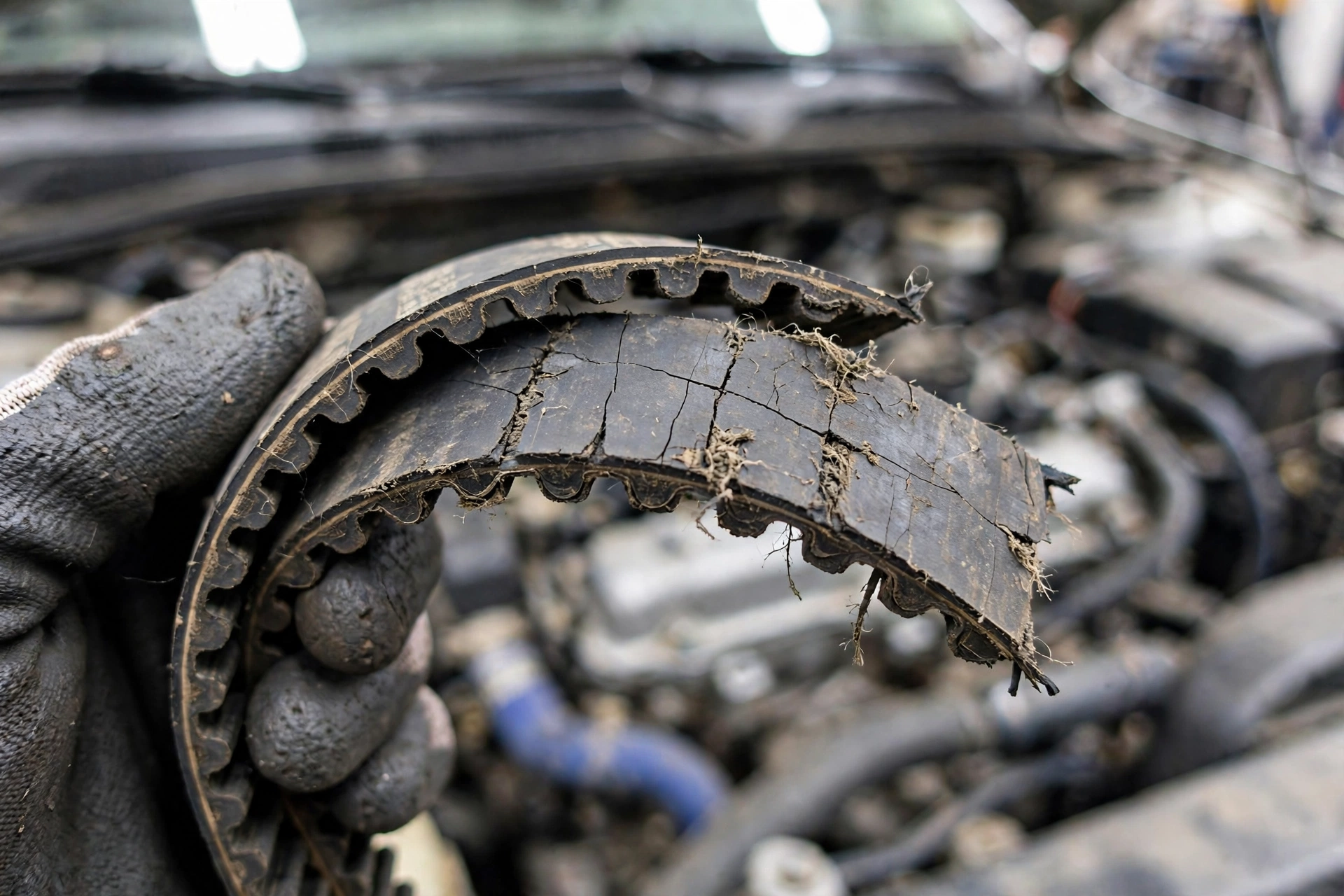
- Visible cracks or fraying. If you can see the belt during an inspection, look for cracks, missing teeth, or shiny glazed spots. Any of these mean replacement is due now.
If you notice more than one of these signs, do not keep driving and hoping for the best. A timing belt that fails on the road leaves you stranded, and the repair bill that follows is far larger than the replacement cost.
When Should You Replace a Timing Belt?
Most manufacturers recommend replacing the timing belt every 60,000 to 100,000 miles, or every 7 to 10 years, whichever comes first. The exact interval is in your owner’s manual, and it matters. A belt that looks fine on the outside can still be weak inside after years of heat cycles.
Some common manufacturer intervals:
- Honda and Toyota: usually 90,000 to 105,000 miles
- Subaru: usually 105,000 miles
- Hyundai and Kia: usually 60,000 miles
- Volkswagen and Audi: usually 75,000 to 100,000 miles
If you bought a used car and have no record of a timing belt change, have a mechanic inspect it. The cost of an inspection is small compared to the cost of guessing wrong. This is one of those maintenance jobs where doing it a little early is smart, and doing it late is expensive.
What Happens If a Timing Belt Breaks?
This is the part that makes timing belt replacement worth every dollar. When a timing belt snaps, the camshaft stops turning while the crankshaft keeps spinning for a moment. The pistons keep moving up and down, and on most modern engines they hit the open valves. The result is bent valves, damaged pistons, and sometimes a cracked cylinder head.
Whether your engine survives a broken belt depends on its design:
- Interference engines: the valves and pistons share the same space at different times. A broken belt almost always causes major internal damage. Repair costs run $2,000 to $4,000 or more, and many owners end up replacing the whole engine.
- Non-interference engines: the valves and pistons never meet, so a broken belt usually just stalls the engine. You still need a tow and a new belt, but the engine itself is fine.
Most modern cars use interference engines for better performance and fuel economy, so you should assume yours is one unless your manual says otherwise. A $700 timing belt job is cheap insurance against a $3,000 engine rebuild.
Timing Belt vs Timing Chain: What Is the Difference?
Some cars use a timing chain instead of a belt. Both do the same job, but they are built very differently.
| Feature | Timing belt | Timing chain |
|---|---|---|
| Material | Reinforced rubber | Metal chain, like a bicycle chain |
| Typical lifespan | 60,000 to 100,000 miles | 200,000 to 300,000 miles, often the life of the car |
| Replacement cost | $500 to $1,000 | $1,500 to $3,000 or more |
| Noise | Quiet | Slightly noisier |
| Maintenance | Must be replaced on schedule | Usually only replaced if it stretches or rattles |
Chains last much longer, but they are not maintenance free. A stretched chain can rattle, throw off the timing, and eventually fail too. If your car has a chain, listen for a rattling noise on cold starts and keep your oil changes on schedule, because clean oil is what keeps a chain alive.
Should You Replace the Water Pump at the Same Time?
Yes, in most cases you should. On many engines, the water pump sits behind the timing cover and is driven by the timing belt. Replacing it later means paying the same 3 to 5 hours of labor all over again. Doing it during the timing belt job adds only $80 to $150 in parts and almost no extra labor.
The same logic applies to the tensioner, idler pulleys, and seals. If your mechanic suggests a full timing belt kit instead of just the belt, they are saving you money in the long run, not upselling you. A full kit job done once is cheaper than two separate jobs done a year apart.
Can You Replace a Timing Belt Yourself?
A skilled home mechanic can replace a timing belt, and the parts for a DIY job cost about $150 to $400. But this is not a beginner repair. The timing marks on the crankshaft and camshaft must line up exactly. If you are off by even one tooth, the engine will run poorly, and if you are off by more, you can bend the valves on the first start.
You will also need a torque wrench, a crankshaft pulley holder, and a service manual for your exact engine. Most owners are better off paying a professional for this job. If you do decide to try it yourself, take photos of every timing mark before you remove the old belt, turn the engine by hand twice after fitting the new belt, and check the marks again before you start the car.
How to Save Money on a Timing Belt Replacement
You cannot skip this job, but you can keep the bill under control:
- Get two or three quotes. Prices vary widely between dealerships and independent shops, sometimes by $300 or more for the same job.
- Use an independent shop you trust. Dealerships charge higher labor rates, and a good independent shop with ASE certified technicians can do the same work for less.
- Replace the water pump and pulleys in the same visit. You pay the labor once instead of twice.
- Do not delay. A belt that is overdue is a gamble. The cost of an engine rebuild after a snapped belt is three to five times the cost of a planned replacement.
- Keep up with your other scheduled maintenance. A car that gets regular service, from a transmission fluid change to a spark plug replacement, is far less likely to surprise you with a breakdown.
Frequently Asked Questions
How much does a timing belt replacement cost in 2026?
Most US drivers pay $500 to $1,000, including parts and labor. Compact cars are usually $400 to $700, while luxury and European cars can reach $1,500. Adding a water pump at the same time costs $150 to $300 extra.
How long does a timing belt replacement take?
The job usually takes 3 to 5 hours at a shop. Some engines with tight access can take a full day, so ask the shop for a time estimate when you book.
What happens if my timing belt breaks while driving?
The engine will stall immediately. On most modern interference engines, the pistons hit the valves and cause major internal damage, with repairs costing $2,000 to $4,000 or more.
Does my car have a timing belt or a timing chain?
It depends on the model and year. Your owner’s manual will say which one your engine uses. As a rule, many Honda, Toyota, Subaru, Hyundai, and VW models use belts, while many newer engines use chains. You can also check the timing belt page on Wikipedia for a general overview of how belts work.
Can I drive with a worn timing belt?
You can, but you should not. A worn belt can snap without further warning, and the damage it causes is far more expensive than the replacement. If your belt is past its service interval or showing cracks, book the replacement this week.
Final Thoughts
A timing belt replacement is one of the most important maintenance jobs your car will ever need. It costs $500 to $1,000, it takes a few hours, and it protects an engine worth many times that amount. Check your owner’s manual for the interval, listen for the warning signs, and replace the belt, tensioner, and water pump together. Your engine, and your wallet, will thank you.
While you plan this repair, also check how much does a catalytic converter replacement cost in 2026, since a failing engine can damage the exhaust system too.